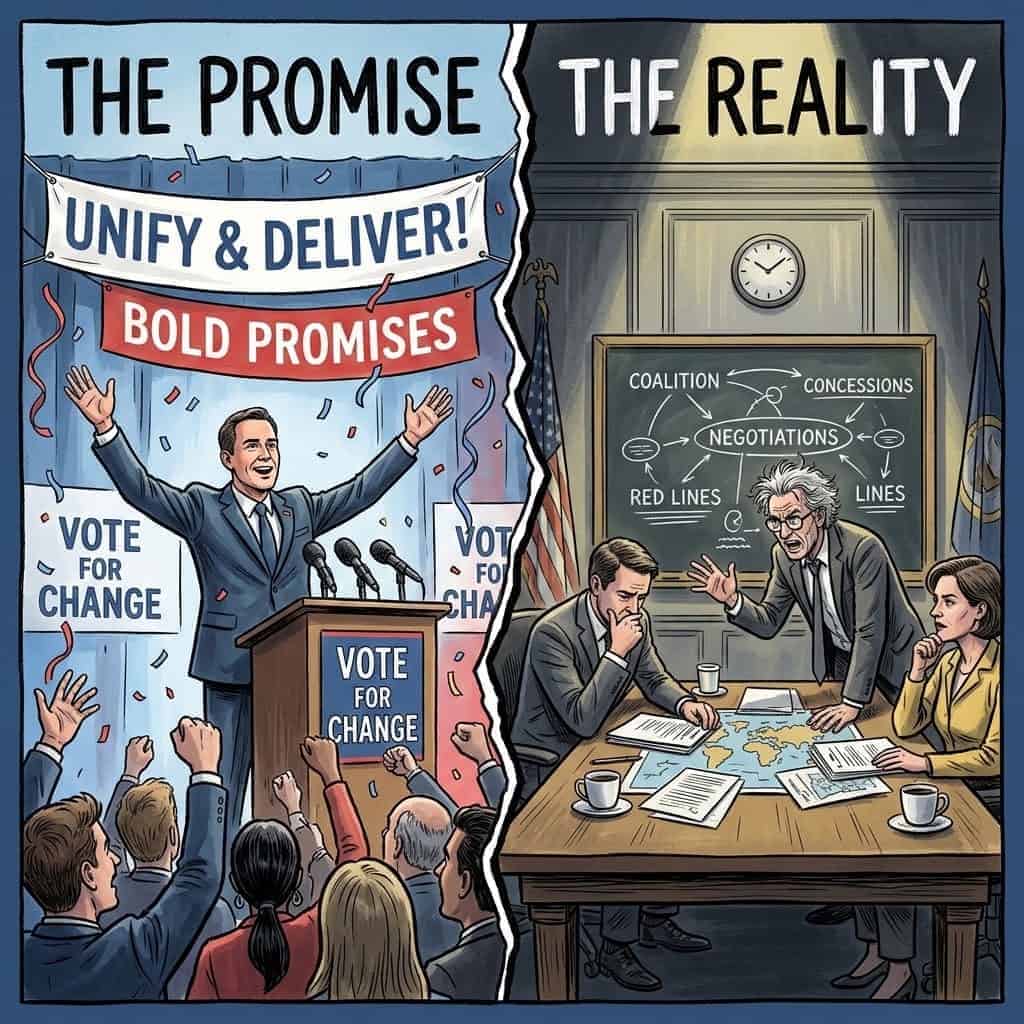
Stockholm, Sweden – Think of the old picture of a campaign. A party leader stands on a stage. They look into the camera. They make a promise. “We will never work with them.” The crowd cheers. The promise goes into the manifesto. Voters remember it.
Now picture the new picture. The election is over. The votes are counted. The party leader is in a room. The math isnt ‘mathing‘ (doesn’t work ) without “them.” The promise is still in the manifesto. It is also in the way.
This is the gap between campaigning and governing. And in Sweden, it has a name: the Tidö Agreement.
The old picture: the promise
In the 2018 election, Ulf Kristersson stood in front of Holocaust survivor Hédi Fried. He allegedly promised her something. He would never cooperate with the Sweden Democrats.
The party had roots in the neo-Nazi movement. It was a pariah. Kristersson’s promise was clear and personal.Now rumours doing rounds allege that he- Kristersson – never said he could not work with SD back in 2022,only on issue of SD being in government!
Fast forward 2026 elections-the same Ulf Kristersson in a press conference says SD claims atleast 12 ministerial posts for more support…Lol…What a turncoat!!!
The Christian Democrats said the same thing. So did the Liberals. For years, the message was uniform: the Sweden Democrats were beyond their reach!They could win votes. They could not win power.
That was the old picture. A firewall made of promises.
The new picture: the deal
Then came 2022. The right bloc won 176 seats. The left bloc won 173. Three seats. The Moderates, Christian Democrats, and Liberals needed the Sweden Democrats to govern. They had a choice: break the promise, or let the left govern.
On 14 October 2022, they signed the Tidö Agreement.
The Sweden Democrats would support the government from the second row. They would get no cabinet ministers. That was the fig leaf. But they would get something more valuable: policy influence.
The agreement contained over 500 action points. Immigration. Crime. Deportation. Police powers. The Sweden Democrats had spent years demanding these things. Now they had a government on it’s leash committed to delivering them .
The Moderates got the prime minister’s office. The Sweden Democrats got the agenda.
The numbers: what the deal actually gave
The Tidö Agreement is not a coalition. It is a confidence and supply arrangement. The Sweden Democrats don’t sit in cabinet. They don’t attend cabinet meetings. But the government cannot pass its budget without them. It cannot survive a no-confidence vote without them.
That is power. Real power.
By 2026, the government had handled roughly two-thirds of the 500-plus action points in the agreement . The Sweden Democrats’ fingerprints were on immigration policy, criminal justice, and deportation rules. The party that promised to shake up Swedish politics had done exactly that – without ever holding a ministerial post.
Experts call this “magnetic power.” We call it witchcraft,hypnosis and magic power.Whichever suits you… The Sweden Democrats created a magnet that dragged the entire government to the right.
The Moderates, Christian Democrats, and Liberals didn’t just cooperate with the Sweden Democrats. They adopted their framing, their priorities, their language .
The firewall didn’t contain the Sweden Democrats. It normalized them.
The voters who felt tricked
Meet Karin (not real name). She is 58. She voted for the Christian Democrats in 2022.
“I trusted them,” she says. “They said they would never work with the Sweden Democrats. I believed them. I voted for a centre-right government that was decent. And then they signed a deal with the SD. I felt tricked. I felt stupid.”
She is not alone. In the 2026 campaign, the Christian Democrats are trying to reach out to the Social Democrats. They are offering cooperation on healthcare, on energy. But voters like Karin remember. “I will not vote for them again,” she says.
The Sweden Democrats themselves acknowledge the shift. Jimmie Åkesson leader of the SD party, joked on the campaign trail, that his one-time rivals now sound like tribute acts.
“We’ve pressed the other parties and now they all sound more or less like us,” he said. “That is, of course, already a victory in itself” .
He is not wrong.
What the promise-breakers say
The Moderates, Christian Democrats, and Liberals do not call it a broken promise.
They call it responsibility.
Their argument: the old firewall was unsustainable. The Sweden Democrats had 20.5 percent of the vote. They were the second-largest party.
Ignoring them meant ignoring one in five voters. The Tidö Agreement was a way to bring them into the fold, to make them govern rather than just protest.
And there is evidence this was a deliberate strategy. By keeping the Sweden Democrats outside the cabinet, the government could claim it kept its promise – no SD ministers -while still using SD votes to govern. It was a fig leaf. But fig leaves matter in politics.
The French version: won, denied
Sweden is not the only country where promises collide with math.
In France, the 2024 snap election produced a shock. The left-wing New Popular Front NFP won the most seats — 182 in the 577-seat National Assembly . By French tradition, the president appoints a prime minister from the largest group. That would have been the NFP.
Macron refused.
He argued that an NFP government would immediately face a no-confidence vote from the centre and right. It would be unable to govern. So he appointed Michel Barnier, a conservative from a party with just 47 seats .
The left called it a “parody of democracy.” Jean-Louis Debré, a former president of the Constitutional Council, said Macron should have let the NFP “take responsibility.” Instead, the president chose a prime minister from the fourth-largest group .
The NFP had won. It was denied. The promise of democracy – you win, you govern- did not survive contact with the president’s judgment.
The pattern
This is the pattern that voters are noticing.
In Sweden, three parties promised never to work with the Sweden Democrats. They broke that promise to form a government. They kept the letter — no SD ministers — and broke the spirit. The SD got policy. The voters who believed the promise got a government they didn’t vote for.
In France, the left won the most seats. The president decided it couldn’t govern. A smaller party got the prime minister’s office. The voters who backed the winning coalition got a government led by someone they opposed.
In both cases, the promises were made for the campaign. The decisions were made for the coalition. The voters were spectators to both.
Two voices
The voter who switched. Meet Per (not real name). He is 47. He voted for the Moderates in 2018. In 2022, he voted for the Sweden Democrats SD.
“I was tired of being told the SD were unacceptable,” he says. “They had 20 percent of the vote. They were the second-biggest party.
The Moderates kept saying they wouldn’t work with them, but they also kept saying they wouldn’t let the left govern.
It was a contradiction. I voted for the party that was honest about what it wanted.”
He pauses. “I don’t feel tricked by the Moderates. I feel like they finally admitted reality. But I understand why other people feel tricked.
The system makes promises it can’t keep. That’s not the voters’ fault. It’s the system’s.”
The voter who stayed home.
Meet Sofia (not real name). She is 39. She voted for the Christian Democrats in 2018. In 2022, she didn’t vote at all.
“I couldn’t do it,” she says. “I couldn’t vote for a party that promised one thing and did another. And I couldn’t vote for the left either.
So I stayed home. I know that means I gave up my voice. But I felt like my voice was already being ignored. What was the point?”
She will vote in 2026. She hasn’t decided for whom. “Maybe I’ll vote for a small party,” she says. “Even if it doesn’t get in. At least I’ll know I didn’t vote for a lie.”
Back to the two pictures
So we return to our two pictures.
In the old picture, a promise is a promise. A party says it will never work with another. It keeps its word. Voters can trust what they hear on the campaign trail. The system is honest, even when it is hard.
In the new picture, a promise is a campaign tool. It wins votes. It signals values. It is not a binding contract. When the math changes, the promise changes. The voters who believed it are told they misunderstood. The voters who didn’t are told they were naive.
The Tidö Agreement is not a scandal. It is a deal, publicly signed, publicly defended. The French refusal to appoint an NFP prime minister is not illegal. It is a presidential judgment, constitutionally permitted.
But both are examples of a system where the campaign is one thing and the government is another.
Where what you vote for is not what you get. Where the promise is made for you and broken for the coalition.
The question:
The question is not whether the politicians lied.
The question is whether a system that makes lying structurally necessary can still call itself democratic!
Other articles in the series: Is ballot democracy still democracy?
When the voters cast their ballots however, it’s the seats and blocs that count in parliament…Not forgetting closed door negotiations for government formation, and a PM whom in some cases ended up being an unelected civil servant.
All articles in the series including the editorial explain the pertinent questions like the why and how’s and present a solution to the question of democracy through electoral voting in some European nations.
Hope you find them of any help… and that would make us at EuroContinentalDispatch.com(The voice of the unheard majority on the European continent) glad!
https://eurocontinentaldispatch.com/articles/the-firewall-when-everyone-agrees-to-ignore-millions
https://eurocontinentaldispatch.com/articles/the-promise-they-broke
https://eurocontinentaldispatch.com/articles/the-4-the-5-and-the-votes-that-vanish
https://eurocontinentaldispatch.com/articles/what-would-actually-fix-this
https://eurocontinentaldispatch.com/articles/sweden-votes-tomorrow-will-it-be-2022-all-over-again
https://eurocontinentaldispatch.com/articles/you-voted-someone-else-chose-how-europes-system-turns-your-ballot-into-a-starting-position
https://eurocontinentaldispatch.com/articles/the-quiet-robbery-why-your-vote-keeps-losing-to-the-fine-print

Columnist & Expert
Euro Continental Dispatch
A dedicated contributor to Euro Continental Dispatch, specializing in investigative reporting and grassroots European perspectives. Committed to providing ground truth from across the Continent.