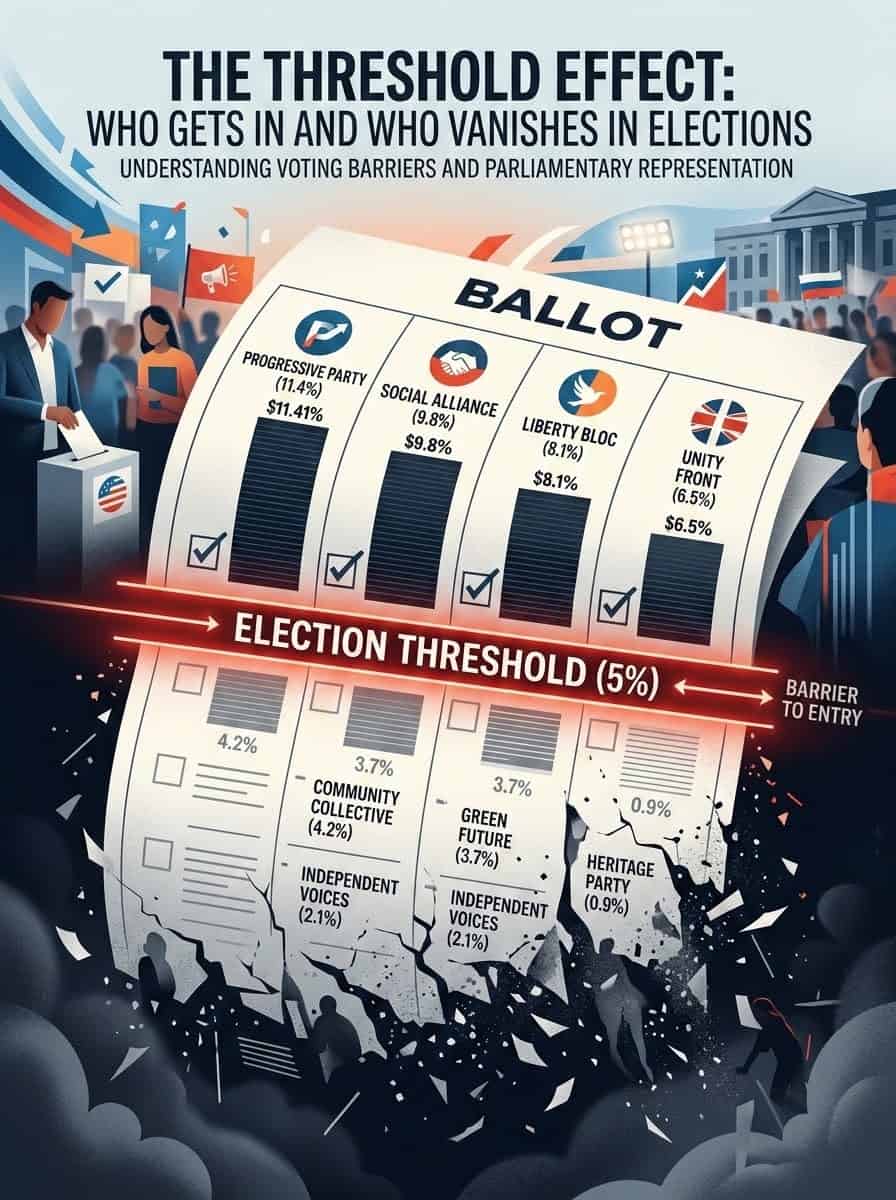
Berlin, Germany – Think of the old picture of voting. You mark a ballot. Your vote joins a pile. The pile is counted. Seats are handed out. Every voice is heard, in proportion. That is the promise.
Now picture the new picture. You mark a ballot. Your vote joins a pile. The pile is counted. And then a line is drawn – not by you, not by the voters, but by the parties already in power.
If your pile is below the line, it is swept away. The seats are handed out to everyone else. Your voice is not heard. It is not even counted as a voice.
This is the threshold. It is the quiet rule that decides whether your vote lives or dies. And it is not a law of nature. It is a choice.
The old picture, in numbers
For most of the twentieth century, the old picture was the dream. Proportional representation meant every vote mattered.
If a party got 3 percent of the vote, it got roughly 3 percent of the seats. Small parties could enter parliament. New voices could be heard.
That picture had a problem. Too many parties meant unstable governments. In Weimar Germany, dozens of parties competed.
Coalitions collapsed. The system buckled. The chaos helped pave the way for dictatorship.
After the war, Germany made a choice. No more chaos. A threshold: 5 percent. Below that, no seats. Sweden followed with 4 percent in 1968. The goal was stability. The cost was silence.
The new picture, in numbers
Germany’s 2025 election showed what that cost looks like.
The Free Democratic Party got 4.3 percent of the vote. The Sahra Wagenknecht Alliance got 4.97 percent . Both fell below the 5 percent threshold. Both got zero seats.
That is roughly 8.9 percent of German voters – nearly one in eleven – whose ballots elected nobody. Their votes were not invalid.
They were not spoiled. They were simply discarded, because the system had decided their choice was too small to count.
The BSW missed the threshold by 9,523 votes. That is about the population of a small town. If 9,523 more Germans had voted for BSW, the party would have entered parliament with 34 seats .
Those 34 seats would have erased Chancellor Friedrich Merz’s twelve-seat majority in the Bundestag (German parliament). The entire government of Europe’s largest economy hinged on a line that fewer than ten thousand people crossed or didn’t cross.
The old picture, in Sweden
Sweden’s threshold is lower – 4 percent instead of 5 – but the effect is the same.
In 2022, the parties below the threshold took about 1.54 percent of the vote. The largest was Partiet Nyans, with 0.44 percent – around 28,000 votes . Not enough.
But here is the number that matters.
The gap between the two blocs in 2022 Swedish elections was 0.7 percentage points – about 46,000 votes . More people voted for parties that got zero seats than the margin that decided who would govern.
The threshold did not just filter fringe parties. It shaped the behavior of parties near the line. The Green Party got 5.08 percent – above the line, but close enough that they ran a campaign explicitly warning voters that a vote for the Greens was a vote to keep them alive.
The strategy worked. The Liberals in Sweden, then at 4.61 percent, survived by less than a percentage point . Their leader called it “a great relief.”
The new picture, in one voice
Meet Jonas (not real name). He is 34. He lives in Leipzig. He voted for BSW in February 2025.
“I read the manifesto,” he says. “I liked what they said about peace and about wages. I thought, finally, a party that speaks to me. I voted. I told my friends to vote. I watched the results come in.
And then I saw the number: 4.97. I knew what it meant. I knew the 5 percent rule. I knew my vote was gone.”
He pauses. “I am not angry at the other parties. I am angry at the rule. Who decided that 4.97 is not enough? Who decided that 5 is the magic number?
It is not in the Bible. It is not in nature. Someone chose it. And that someone wanted to keep people like me out.”
The old picture, in another voice
Meet Ingrid (not real name). She is 61. She lives in Malmö. She has voted in every Swedish election since 1982. She has seen the threshold shape politics for decades.
“I remember when the Greens first came in,” she says. “They were small. They were radical. Everyone said they would disappear.
But they stayed. And they changed things. They made the other parties take climate seriously. That is what small parties do. They push.”
She voted for the Greens in 2022. Not because she loved them, but because she wanted them above the line. “It is tactical,” she says. “I was not voting for my first choice. I was voting to keep a voice in the room.”
Is that democracy? We do not know. But it is what the system makes you do!
Why the line is where it is
The threshold is not a neutral rule. It is a political choice. And the people who made it had interests.
In Germany, the 5 percent threshold was set after the war. It was designed to keep out the extremes. But it also kept out new parties, smaller voices, and movements that the established parties did not want to deal with.
In Sweden, the 4 percent threshold was introduced in 1968, when the Riksdag (Swedish parliament) had five parties. It was meant to keep the parliament manageable. It also kept the Social Democrats and the centre-right in control.
The parties that set the threshold are the parties that survive it. They write the rules. They benefit from the rules. They do not have an incentive to change them.
Back to the two pictures
So we return to our two pictures of voting.
In the old picture, every vote counts. A party with 3 percent gets 3 percent of the seats. Small voices are heard. New movements can grow. Democracy is messy, but it is responsive.
In the new picture, a line decides. Below the line, your vote is discarded. Above it, it is counted. The line is drawn by the parties already in power. The parties already in power survive it. The system is stable. The system is also silencing.
The 2026 Swedish election will be decided by a handful of seats. Some of those seats will be decided by votes that were above the line or below it.
Some of the voters who chose a party that fell below the line will watch the results and feel what Jonas felt in Leipzig: that their vote was not a mistake, but a discard.
The threshold is not a conspiracy. It is a rule. But rules are written by someone. And someone decided that your vote should die at 4.97.
The question is not whether the rule is fair. The question is who it is fair for?
Other articles in the series: Is ballot democracy still democracy?
When the voters cast their ballots however, it’s the seats and blocs that count in parliament…Not forgetting closed door negotiations for government formation, and a PM whom in some cases ended up being an unelected civil servant.
All articles in the series including the editorial explain the pertinent questions like the why and how’s and present a solution to the question of democracy through electoral voting in some European nations.
Hope you find them of any help… and that would make us at EuroContinentalDispatch.com(The voice of the unheard majority on the European continent) glad!
https://eurocontinentaldispatch.com/articles/the-firewall-when-everyone-agrees-to-ignore-millions
https://eurocontinentaldispatch.com/articles/the-promise-they-broke
https://eurocontinentaldispatch.com/articles/the-4-the-5-and-the-votes-that-vanish
https://eurocontinentaldispatch.com/articles/what-would-actually-fix-this
https://eurocontinentaldispatch.com/articles/sweden-votes-tomorrow-will-it-be-2022-all-over-again
https://eurocontinentaldispatch.com/articles/you-voted-someone-else-chose-how-europes-system-turns-your-ballot-into-a-starting-position
https://eurocontinentaldispatch.com/articles/the-quiet-robbery-why-your-vote-keeps-losing-to-the-fine-print

Columnist & Expert
Euro Continental Dispatch
A dedicated contributor to Euro Continental Dispatch, specializing in investigative reporting and grassroots European perspectives. Committed to providing ground truth from across the Continent.