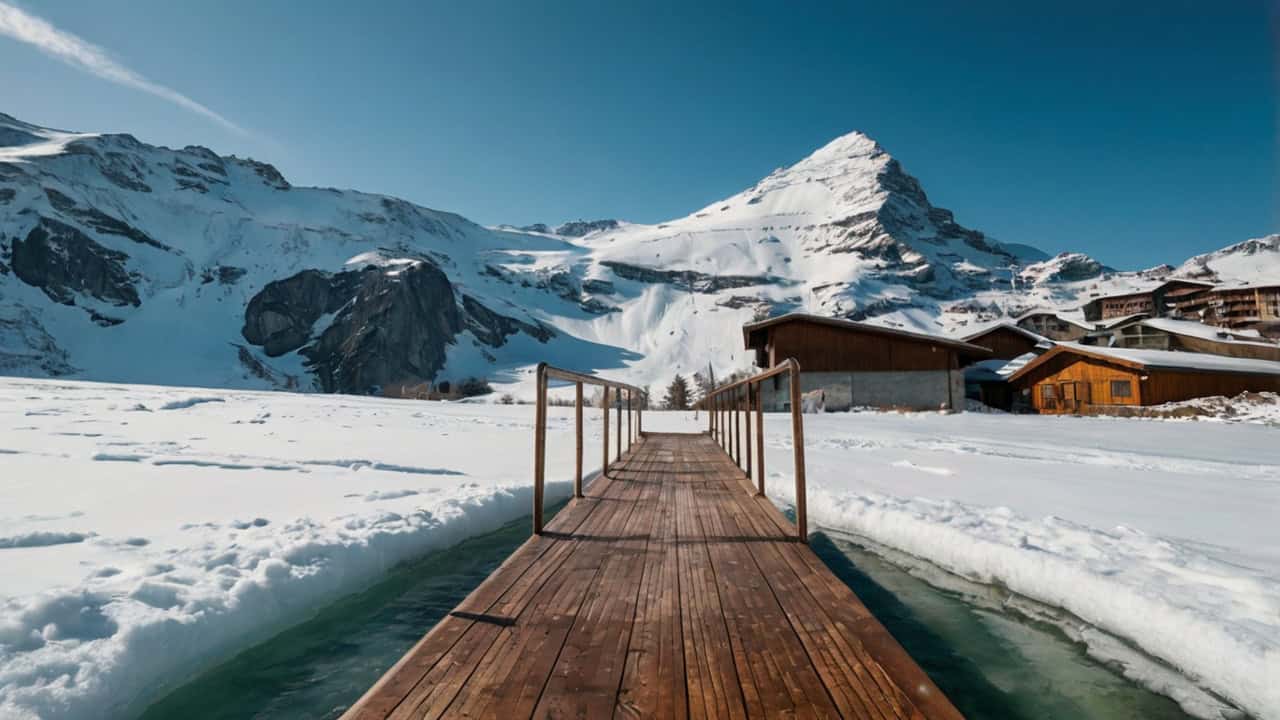
The Alpine Shift: Climate Adaptation in Practice. How Swiss mountain villages are trading skis for yoga mats.
Langenbruck, Switzerland –You know that Swiss winter postcard. White silence. Ski lift gears clanking. Fondue smell.
For a hundred years, that was the deal. Snow fell. Tourists came. Villages did well.Now look at the lower foothills of the Jura or the Prealps.
Hills are brown and green. The T-bar lift sits silent. Cables rusting in January rain. Only sound is wind moving through pine trees.
Trees that are thirsty.They have a name for this shift. Hitzestress-Flucht. Heat stress escape.Winter economy is dying.
Cool-cation anyone?
But a new summer economy is being born. Tourists aren’t coming for ski thrills anymore. They’re coming for the cool-cation.
Fleeing southern Europe’s brutal heat. Looking for high-altitude chill.New data from January 2026 backs it up. Traditional ski visits at low-altitude resorts have collapsed. But summer overnight stays in the Alps? Up 4.1 percent.
Switzerland is swapping skis for yoga mats.How does a country built on winter survive when the snow goes away?
The Numbers Tell The Story.
There’s this thing called the “Snow Reliability Line.” Most watched stat in the country.
Swiss Federal Institute for Forest, Snow and Landscape Research says the reliable snow line has crept above 1,500 meters. Villages below that? Business model is broken.Switzerland had 545 ski locations.
Nearly 40 percent have either closed or sit inactive.The government’s “Innotour” program shifted millions of francs.
Away from snow cannons. Toward four-season infrastructure. Mountain bike trails. Forest bathing platforms.Simple truth. The Alps aren’t a winter sports arena anymore. They’re becoming a summer climate refuge.
A Tale of Two Mountains.
This isn’t just weather changing. It’s identity.Meet Beat(not real name). Sixty-four years old. Ran the ski lift in a small village in Canton Solothurn for forty years.
The lift hasn’t run a full week since 2023. He spends his days maintaining machines that may never spin again.”
They talk about ‘transformation,'” Beat says. Greasing a gear that doesn’t need it. “But you can’t transform a culture overnight.
My father taught me to ski on this hill. Now they want me to guide tourists to look at flowers? A mountain without snow is just a steep field.”
High-tech wellness spot.
Now meet Amani(not real name). Thirty-two years old. Wellness professional at a newly converted bio-resort in the Valais. The building used to be a ski lodge. Now it’s a high-tech wellness spot.
Amani is part of the new global workforce of the Alps. He walks through the lobby with a tablet.
Speaks softly into his headset in Kiswahili to a potential client in Nairobi,Kenya, looking to escape equatorial heat.“Karibu sana, hali ya hewa hapa ni nzuri.“ Welcome, the weather here is beautiful. He smiles. “
We offer clean air, silence, and temperatures that let you sleep.”To Beat, the mountain is a place of action that got paused.
To Amani, the mountain is a product-Alpine freshness. More valuable than ever in a warming world.
The Government’s Answer: ‘Managed Retreat’.
Swiss government is pragmatic. They’re managing a retreat from lower elevations.
Through the Adapt+ program and Innotour, they subsidize dismantling old ski infrastructure. Pay villages to remove rusting pylons. Rewild the slopes.Critics call it a “rich man’s transition.”
“Rich man’s transition”
Wealthy resorts like St. Moritz and Zermatt have altitude and money. They can build higher lifts. Make snow.
Smaller villages that made skiing accessible to working class? They’re told to become hiking hubs or die.Result?
Gentrification of winter.
Skiing becomes luxury for the elite. Masses get wellness walks in the mud.The Public feeling mood in the valleys is mixed.
Grief and relief.Swiss Tourism Federation surveys show locals mourn losing the “Ski Week” tradition. But there’s growing acceptance.
The fear of empty beds is shifting to fear of over-tourism in summer.Places like Lauterbrunnen are putting up gates to control summer crowds. Winter silence is gone. Replaced by year-round traffic noise.
Back to the two pictures.So back to the village square.
Old picture-Village quiet in July. Bursting with life in January. Lived by the rhythm of seasons.
New picture-Seasons blurred. Village is a climate shelter. Busy when the world is hot. Quiet when the world is gray.Beat looks at the forecast. Rain. Again.
While, Amani looks at his bookings. Full.The Alps are shifting.
Question for 2026 isn’t whether snow will come back.It’s whether the people who live there can recognize their home without it.

Columnist & Expert
Euro Continental Dispatch
A dedicated contributor to Euro Continental Dispatch, specializing in investigative reporting and grassroots European perspectives. Committed to providing ground truth from across the Continent.