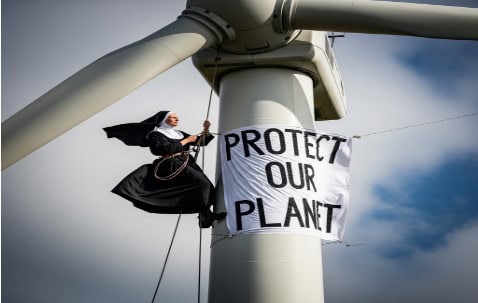
While politicians stall, sisterhoods turn cloisters into power plants.
Normandy, France – You know the traditional European nun. Cloistered. Quiet. Lives behind stone walls. Prays for a world she’s entirely separated from. Her devotion stays invisible. Her life is a quiet surrender to ancient church rules.
Now, picture Sister Brigitte today. Sixty-eight years old. Suspended sixty meters in the air. Her habit whips like a battle flag in the gale as she climbs a wind turbine. Engineers below watch in shock as she secures a massive banner protesting fossil fuels.
“This isn’t rebellion,” she shouts over the wind. “It’s prayer with tools.”They call this shift Ecological Obedience. A movement that fuses ancient mystical urgency with gritty modern climate action.
For centuries, the church treated earth as a temporary waiting room for heaven. Today, a new generation of sisters views soil itself as sacred.
New 2024 data reveal a startling reality. Government climate targets keep getting missed. Meanwhile, Europe’s sisterhoods engineer a quiet revolution.
How did the most traditional women in the Catholic Church become its most radical environmentalists?
The Numbers Tell The Story
Numbers expose the gap between political talk and monastic action.
European Commission’s Covenant of Mayors Climate Report, 2024. Europe’s convents go carbon-negative at twice the rate of national governments.
Laudato Si’ Action Platform at the Vatican tracks the European Monastic Sustainability Audit. Numbers stagger.
132 convents now run completely off the national grid. Nearly 70 percent of monitored convents launched renewable energy projects. Planted over 300,000 trees since 2020. Created 42 square kilometers of wildlife corridors. Trained over 15,000 European citizens in sustainable farming and energy management.
Simple truth. Politicians draft treaties. Nuns build grids.
The Bureaucrat and The Practitioner
Not just about solar panels. A clash over what faith should look like.
Meet Cardinal Gerhard Müller. Old Vatican power. Believes the church’s duty is strictly spiritual. In February 2024, he published a harsh condemnation in Die Tagespost. Criticized these “activist nuns.”
Said sisters belong in contemplative service, not chained to pipelines. For the Cardinal, faith is private. Interior.
Now meet Mother Hélène. Prior of the Soeurs de la Terre in Belgium. In 2018, she noticed songbirds disappearing from dawn prayers.
Realized that if creation is God’s manuscript, fading ink demands action. Rewrote her order’s ancient rules. Included carbon fasting. A total ban on pesticides.
When Cardinal Müller’s diocese sold forest land to fracking companies, Sister Brigitte and her peers chained themselves to trees. Some call it radical disobedience.
Sister Brigitte calls it utunzaji wa uumbaji. The custody of creation. Translating the Latin mandate into Kiswahili spoken by her African novitiates.
The cardinal protects the institution. The nuns protect the dirt on which the institution stands.
Tactics of the Eco-Network
This ecological obedience runs highly organized. Highly technical.
Frauenchiemsee Abbey in Bavaria. Benedictine sisters don’t just pray. They operate the region’s first monastic-owned solar grid.
Sister Scholastica says their surplus energy powers 300 local homes. All profits go to climate refugees. “We turned our cloister into a power plant. The ultimate ora et labora.” Pray and work.
Sicily. Suore dell’Agricoltura Sacra become genetic guardians. Saving near-extinct medieval crops through public adoption schemes.
The most dramatic shift is in Poland. Coal-choked Silesia region. Nuns partnered with former NASA scientists to deploy mycoremediation. Using fungi to clean toxic soil.
Transformed mining wastelands into the “Lungs of Silesia.” Planted 47,000 birch trees to filter coal dust. A 2023 study by the Kraków Institute of Ecology confirmed a 28 percent drop in air pollution in convent zones.
The Public Feeling
Public response shifts church demographics.
Traditional parishes bleed members. “Green orders” see a surge. Dr. Lise Van Acker writes in Eco-Theology Review. Fastest-growing cohort entering these specific sisterhoods? Women aged 18 to 25.
Young people, sick of state inaction and institutional hypocrisy, flock to these women. See a network that answers to a higher authority than the stock market. See women saving souls and saving soil at the same time.
Back to the Two Pictures
So back to the abbey.
Old picture. The convent was a fortress. Designed to keep the dangerous world out. Nuns retreated inside to pray for salvation.
New picture. Convent is a laboratory. Doors open. Roof covered in glass panels. Nuns scaling turbines.
Stalled climate negotiations of 2026 ask a simple question. Who does more to save the earth?
The men in suits sitting in conference halls? Or the women digging in the dirt?
Sister Brigitte checks her safety harness. Wind picks up. Prayer continues…

Columnist & Expert
Euro Continental Dispatch
A dedicated contributor to Euro Continental Dispatch, specializing in investigative reporting and grassroots European perspectives. Committed to providing ground truth from across the Continent.